Hammertoes Explained: Types, Causes, and Treatment Options
Hammertoes are one of the most common foot deformities treated by podiatrists and foot specialists. If you’ve noticed one of your toes curling downward or developing painful pressure points in shoes, you may be dealing with a hammertoe.
What Is a Hammertoe?
A hammertoe is a deformity where one or more smaller toes bend abnormally at the joints due to muscle and tendon imbalance.
Each toe contains three joints:
• Metatarsophalangeal joint (MTP) – where the toe meets the foot
• Proximal interphalangeal joint (PIP) – the middle joint
• Distal interphalangeal joint (DIP) – the joint near the tip
When the muscles and tendons that control these joints become imbalanced, one joint may bend while others compensate, creating a curved or claw-like toe position.
According to the American Academy of Orthopaedic Surgeons, hammertoes often begin as flexible deformities but can become rigid over time if untreated.
The Three Main Types of Hammertoes
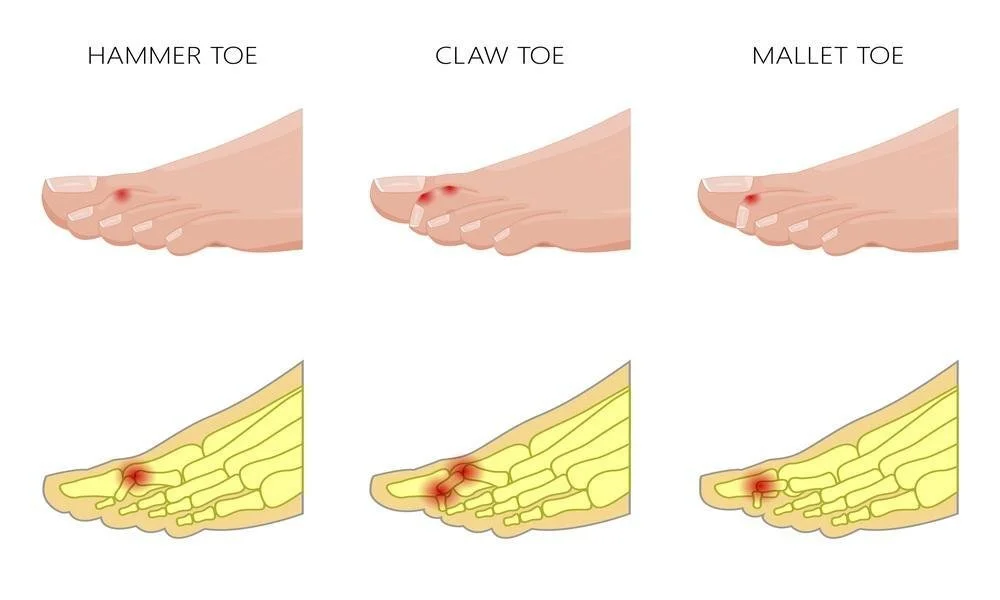
Understanding the type of hammertoe is important because treatment approaches differ depending on the joint involved.
Traditional Hammertoe
A classic hammertoe occurs when the middle joint (PIP) bends downward while the MTP joint may bend upward.
Common symptoms include:
Toe bent in the middle
Pain in shoes
Corns or calluses on top of the toe
Redness from shoe pressure
This is the most common hammertoe deformity.
Mallet Toe
A mallet toe affects the distal joint (DIP), the joint closest to the tip of the toe.
Symptoms often include:
Pain at the tip of the toe
Nail irritation
Calluses at the end of the toe
Mallet toes often develop from tight shoes or repetitive pressure on the toe tip.
Claw Toe
A claw toe involves multiple joints bending simultaneously.
The pattern typically includes:
MTP joint bending upward
PIP and DIP joints bending downward
This creates a claw-like shape. According to the Mayo Clinic, claw toes may sometimes be associated with nerve or muscle conditions such as diabetes-related neuropathy.
Why Do Hammertoes Develop?
Dr. Sam highlights one of the most important causes in the reel: Muscle and tendon imbalance.
Your toes are controlled by multiple structures including:
Extensor tendons (top of the foot)
Flexor tendons (bottom of the foot)
Intrinsic muscles such as lumbricals
The plantar plate, which stabilizes the toe joint
When one group of muscles pulls harder than another, the toe can gradually shift into a bent position. The American Orthopaedic Foot & Ankle Society notes that several factors may contribute to this imbalance.
Common risk factors include:
Tight or narrow shoes
High heels
Foot structure differences
Long second toes
Flat feet or high arches
Neurological conditions
Prior foot injuries
Flexible vs Rigid Hammertoes
Hammertoes often progress in stages.
Flexible Hammertoe
The toe can still be straightened manually.
Treatment is usually easier at this stage.
Rigid Hammertoe
The joint becomes stiff and permanently bent.
Rigid hammertoes are more likely to cause:
Pain
Corns
Pressure sores
Shoe difficulty
At this stage, surgical treatment may sometimes be considered.
When Should You See a Foot Doctor for Hammertoes?
You should consider seeing a podiatrist if you experience:
Persistent toe pain
Difficulty wearing normal shoes
Corns or recurring calluses
A toe that appears progressively more bent
Signs of infection or skin breakdown
Early intervention often allows for simpler treatment options.
Hammertoe Frequently Asked Questions
Are hammertoes permanent?
Early hammertoes may be flexible and manageable with conservative treatments, but rigid hammertoes typically do not correct on their own.
Do hammertoes get worse over time?
They can. Without treatment or shoe modifications, deformity and symptoms may gradually progress.
What shoes are best for hammertoes?
Shoes with a wide toe box, soft upper materials, and adequate depth often reduce pressure on bent toes.
Is hammertoe surgery common?
Surgery is typically considered when conservative treatments fail and pain significantly affects daily activity.
Related Articles in this Series
References
American Academy of Orthopaedic Surgeons – Hammer Toe and Claw Toe
American Orthopaedic Foot & Ankle Society – Hammer Toe Information
Mayo Clinic – Hammertoe and Mallet Toe: Symptoms and Causes
