Hammertoe Surgery Complications: Plantar Plate Injury and Excess Skin Explained
Hammertoe surgery is a common and effective way to correct painful toe deformities. Most patients experience significant improvement in comfort, mobility, and shoe fit after treatment.
However, as with any surgical procedure, there are potential complications patients should understand.
In this last part of our hammertoe series, we’re discussing two additional possible complications after hammertoe surgery. Understanding these possibilities helps patients set realistic expectations and make informed decisions about treatment.
Quick Answer: What Are Less Common Hammertoe Surgery Complications?
Two additional complications sometimes discussed after hammertoe surgery include:
Plantar plate rupture – injury to a stabilizing structure under the toe joint
Excess skin – cosmetic changes that occur when the toe is shortened or repositioned
In most cases, these issues are either rare or primarily cosmetic, and they usually do not affect the overall success of the surgery.
What Is the Plantar Plate?
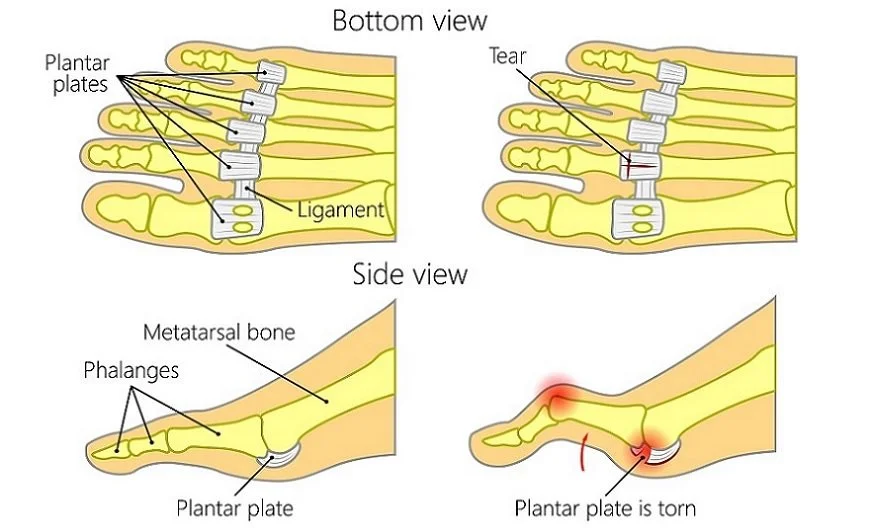
The plantar plate is a thick ligament-like structure located underneath the metatarsophalangeal (MTP) joint, where the toe meets the foot.
Its primary functions include:
Stabilizing the toe joint
Supporting weight during walking
Preventing the toe from drifting upward
According to the American Orthopaedic Foot & Ankle Society, plantar plate injuries can contribute to forefoot pain and toe deformities such as hammertoes or crossover toes.
Complication #1: Plantar Plate Rupture
A plantar plate rupture occurs when the stabilizing tissue under the toe joint becomes torn or weakened.
While it can technically occur during forefoot surgery, there’s an important detail many patients don’t realize:
Many people with hammertoes already have plantar plate damage before surgery.
Because hammertoes develop due to long-term mechanical imbalance, the structures around the joint, including the plantar plate, may already be stretched or injured.
Why Surgery Often Improves Plantar Plate Symptoms
Correcting the toe deformity can actually:
reduce pressure on the joint
improve alignment
relieve pain caused by instability
The American Academy of Orthopaedic Surgeons notes that toe deformity correction procedures can help restore more normal joint mechanics.
For this reason, plantar plate injury is not usually the main concern for patients undergoing hammertoe correction.
Complication #2: Excess Skin After Hammertoe Surgery
Interestingly, one of the most common complaints after hammertoe surgery isn’t functional. It’s cosmetic.
When a toe is shortened, repositioned, and/or straightened there may be extra skin remaining around the toe.
Why Extra Skin Happens
Hammertoes often develop over many years. During that time:
the toe bends
soft tissues adapt
skin stretches around the deformity
When the toe is corrected surgically and becomes shorter or straighter, the skin that previously stretched around the deformity may appear slightly loose or wrinkled.
Does Excess Skin Cause Problems?
In most cases, excess skin is purely cosmetic and not painful nor harmful. It usually does not affect walking, balance, or long-term function.
For many patients, the trade-off of having a straight, pain-free toe outweighs the cosmetic change.
Setting Realistic Expectations for Hammertoe Surgery
Every surgical procedure involves balancing:
function
pain relief
appearance
For hammertoe correction, the primary goals are:
straightening the toe
relieving pressure and pain
improving shoe comfort
restoring function
Cosmetic changes like small wrinkles in the skin may occur but typically do not impact the success of the procedure.
Hammertoe Treatment in Columbus, Ohio
If you’re experiencing:
painful hammertoes
bent or rigid toes
recurring corns or calluses
difficulty wearing shoes
evaluation by a foot specialist can help determine the best treatment approach.
At AM Physicians, Dr. Sam evaluates:
toe flexibility
tendon balance
joint stability
plantar plate integrity
This helps determine whether conservative care or surgical correction is the most appropriate option.
Hammertoe Surgery FAQ
Is plantar plate rupture common after hammertoe surgery?
It is relatively uncommon and many patients already have plantar plate damage prior to surgery.
Can hammertoe surgery fix plantar plate pain?
In some cases, correcting toe alignment may reduce pressure and improve symptoms.
Is extra skin after hammertoe surgery normal?
Yes. Because the toe is often shortened or straightened, some extra skin can remain temporarily or permanently.
Does excess skin require additional treatment?
Usually no. It is typically a cosmetic concern rather than a medical problem.
Related Articles in this Series
References
American Orthopaedic Foot & Ankle Society – Plantar Plate Injury
American Academy of Orthopaedic Surgeons – Hammertoe and Claw Toe
Mayo Clinic – Hammertoe Overview
