Bunions Explained: What They Are, What Helps, and When Surgery Makes Sense
Bunions are one of the most common foot complaints we see and also one of the most misunderstood.
In his most recent reel, Dr. Sam explains something important: A bunion is a bony deformity.
If the problem is bony, the true correction is also bony. That doesn’t mean everyone with a bunion needs surgery. But it does mean we need to be realistic about what non-surgical treatments can and cannot do.
Let’s break it down.
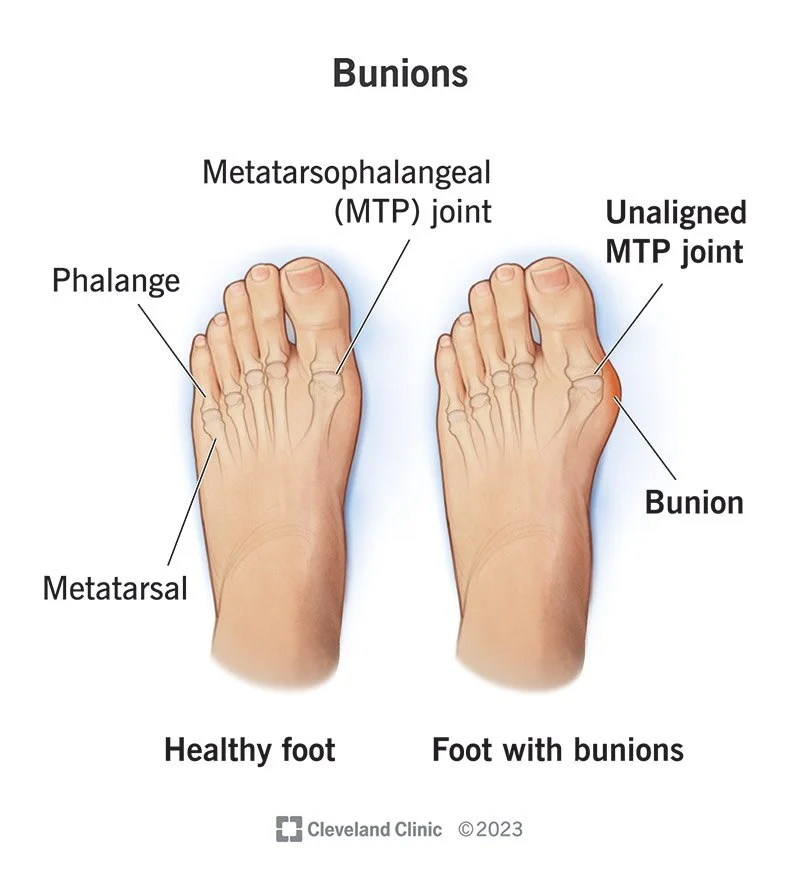
What Is a Bunion?
A bunion, medically called hallux valgus, is a structural deformity at the base of the big toe (the first metatarsophalangeal joint, or 1st MPJ).
In simple terms:
The first metatarsal bone drifts away from the foot
The big toe drifts in toward the toes
A visible bump forms at the joint
This misalignment creates pressure, inflammation, and sometimes pain.
According to the American Academy of Orthopaedic Surgeons (AAOS), bunions tend to worsen over time and can be influenced by genetics, foot structure, and shoe choices.
Why Bunions Happen
Bunions are not just “a bump from tight shoes.”
Contributing factors include:
Genetic foot structure
Flat feet or hypermobility
Abnormal biomechanics
Inflammatory arthritis
Narrow or high-heeled footwear
The American Orthopaedic Foot & Ankle Society (AOFAS) notes that footwear does not directly cause bunions, but poorly fitting shoes can accelerate symptoms in people who are already predisposed.
Can Pads, Splints, or Braces Fix a Bunion?
Short answer: No, they cannot reverse the deformity.
Because bunions involve bone alignment, external devices cannot move the bones back permanently.
However, conservative treatments can absolutely help with symptoms:
Wider toe-box shoes
Padding over the bunion
Toe spacers (temporary alignment relief)
Orthotics for biomechanical support
Anti-inflammatory strategies
Research published in Foot & Ankle International and The Journal of Foot and Ankle Research shows that conservative care may reduce pain but does not correct angular deformity.
When Should a Bunion Be Fixed?
Not all bunions need surgery.
You may not need surgery if:
It doesn’t hurt
It doesn’t limit your activity
It’s not progressing significantly
You should consider evaluation if:
You have persistent pain
Walking becomes difficult
Shoes are increasingly uncomfortable
The deformity is worsening
You develop second-toe problems
The AAOS recommends surgery primarily for pain relief and functional improvement not purely cosmetic reasons.
What Does Bunion Surgery Actually Do?
There are many surgical techniques — over 100 described in literature — but most fall into categories that:
Cut and realign the first metatarsal (osteotomy)
Fuse unstable joints (Lapidus procedure)
Address soft tissue imbalance
Correct associated deformities
The Lapidus Procedure
Dr. Sam mentions the Lapidus procedure as a personal favorite.
This procedure:
Fuses the first tarsometatarsal joint
Stabilizes hypermobility
Corrects deformity at its structural origin
Studies in Foot & Ankle International show high correction power and strong long-term stability, particularly in patients with instability or severe deformity. Modern fixation techniques have significantly improved outcomes and consistency compared to decades ago.
What About Cosmetic Bunion Surgery?
It’s important to pause here. Surgery carries:
Recovery time
Temporary mobility limitations
Swelling (often for months)
Risk of complications
If your bunion does not hurt and does not impair function, cosmetic surgery should be considered carefully and thoughtfully. That said, if pain is affecting your quality of life, surgical correction today has strong success rates when performed appropriately.
The Bottom Line
Bunions are structural deformities.
Pads can reduce pressure. Shoes can reduce irritation. Orthotics can support mechanics. But only surgery corrects bone alignment. Not everyone needs it, but if it hurts, it’s worth evaluating.
If you have a painful bunion, we’re happy to assess it at AM Physicians and discuss what makes sense for your foot, your activity level, and your goals.
References
American Academy of Orthopaedic Surgeons. Bunions (Hallux Valgus). OrthoInfo.
American Orthopaedic Foot & Ankle Society. Bunion (Hallux Valgus). FootCareMD.
Nix S, et al. Conservative management for hallux valgus. Journal of Foot and Ankle Research.
Dayton P, et al. Outcomes of the Lapidus procedure. Foot & Ankle International.
